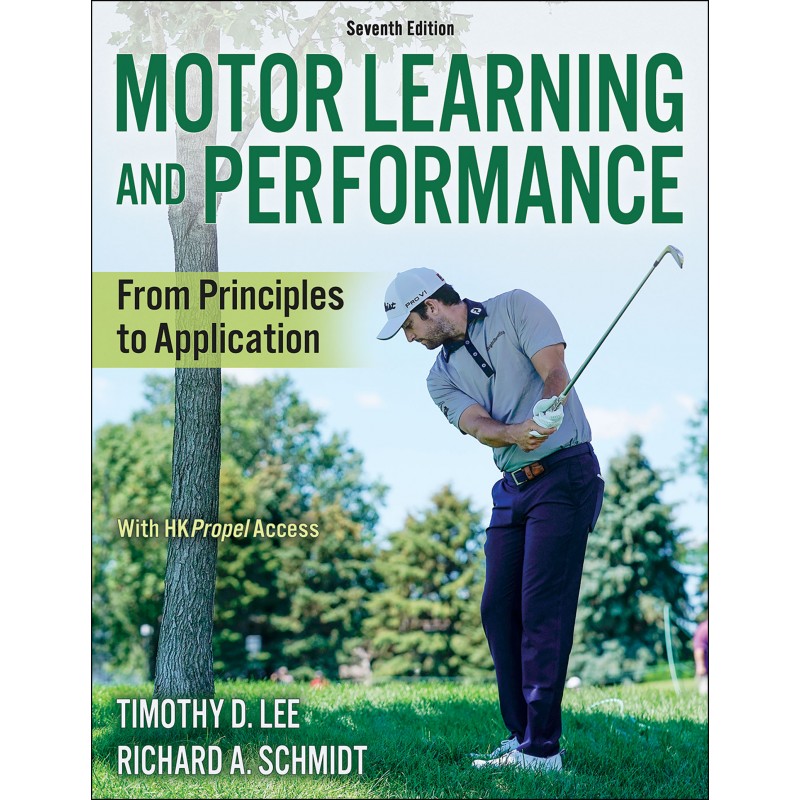
This is the loose-leaf version of Motor Learning and Performance, Seventh Edition With HKPropel Access, which offers students a less expensive, printed version of the text.
Motor Learning and Performance:: From Principles to Application, Seventh Edition With HKPropel Access, constructs a conceptual model of factors that influence motor performance, outlines how motor skills are acquired and retained with practice, and shows students how to apply the concepts to a variety of real-world settings. Written in a style that is accessible even to students with little or no knowledge of physiology, psychology, statistical methods, or other basic sciences, this text enables students to appreciate high-level skilled activity and understand how such incredible performances occur.
The seventh edition of Motor Learning and Performance offers a new chapter that invites students to expand their thinking about the learning process by considering various theoretical explanations for how motor learning occurs. This latest edition has been carefully revised to incorporate the most recent and important research findings in the field, and it is supplemented with practice situations to facilitate a stronger link between research-based principles and practical applications.
Related multimedia components delivered through HKPropel further enrich the learning experience with 12 principles-to-application exercises, 53 interactive activities, and 27 lab activities that can be filled in online and printed or emailed. The 47 narratives from Motor Control in Everyday Actions that are referenced in the book have been updated and are provided in their entirety to illustrate how motor behavior is applicable to real life. Key term quizzes and flash cards offer students interactive opportunities to engage with the content-all of which can be assigned, and progress tracked, by instructors directly through HKPropel. In addition, chapter quizzes that test comprehension of critical concepts may be assigned and are automatically graded.
As the text investigates the principles of human performance, pedagogical aids such as learning objectives, key terms, and Check Your Understanding questions help students stay on track with learning in each chapter. Focus on Research and Focus on Application sidebars deliver more detailed research information and make connections to real-world applications in areas such as teaching, coaching, and therapy. Photo learning activities challenge students with visual exercises, and 48 figures with enlightening audio descriptions can be accessed via QR code.
The seventh edition of Motor Learning and Performance goes beyond simply presenting research-it challenges students to grasp the fundamental concepts of motor performance and learning and then go a step further by applying the concepts. Incorporating familiar scenarios brings real-world context to the material for students, leading to better retention and greater interest in practical application of motor performance and learning in their everyday lives and future.
Note:: A code for accessing HKPropel is included with all new print books.
Chapter 1. Introduction to Motor Learning and Performance How Skills Are Studied Why Study Motor Skills? The Science of Motor Learning and Performance Focus on Research 1.1 Paul M. Fitts Focus on Research 1.2 Franklin M. Henry Defining Skills Components of Skills Classifying Skills Measuring Skilled Performance Understanding Performance and Learning Summary HKPropel Activities
Part I. Principles of Skilled Performance
Chapter 2. Processing Information and Making Decisions The Mental Side of Human Performance The Information-Processing Approach Focus on Application 2.1 Intent to Blow Whistle Rule in the NHL Reaction Time and Decision-Making Focus on Research 2.1 Hicks Law Focus on Application 2.2 Population Stereotypes Focus on Research 2.2 Studying the Expert Advantage Focus on Application 2.3 Cost-Benefit of Anticipating in Sprint Starting Errors in Decision-Making Memory Summary HKPropel Activities
Chapter 3. Attention and Performance Information-Processing Limitations Focus on Application 3.1 William James on Attention What Is Attention? Attentional Limitations in Stimulus Identification Focus on Research 3.1 A Stroop-Like Effect in Basketball Attentional Limitations in Response Selection Focus on Research 3.2 Distracted-Driving Research Attentional Limitations in Movement Programming Focus on Research 3.3 The Double-Stimulation Paradigm Attentional Focus During Action Decision-Making Under Stress Focus on Application 3.2 Driver Panic and Unintended Acceleration Summary HKPropel Activities
Chapter 4. Sensory Contributions to Skilled Performance Feedback Processing in Motor Control Sources of Sensory Information Focus on Application 4.1 When Vision Distorts Performance Processing Sensory Information Focus on Application 4.2 Force Escalation Between Siblings Vision and Motor Control Focus on Research 4.1 Blindsight Reveals Dorsal and Ventral Stream Processing Focus on Research 4.2 Gaze Control and the Quiet Eye Audition and Motor Control Summary HKPropel Activities
Chapter 5. Motor Programs Motor Control of Brief Actions Motor Program Theory Evidence for Motor Programs Focus on Research 5.1 The Henry-Rogers Experiment Focus on Application 5.1 Checked Swings in Baseball Focus on Research 5.2 Initiating a Motor Program Motor Programs and the Conceptual Model Problems in Motor Program Theory: Novelty and Storage Generalized Motor Program Theory Focus on Research 5.3 Invariances and Parameters Focus on Application 5.2 Relative-Timing Biometrics Focus on Application 5.3 The Stereo System Analogy Summary HKPropel Activities
Chapter 6. Principles of Speed, Accuracy, and Timing Controlling Simple Movements Fitts Law Focus on Research 6.1 Fitts Tasks Focus on Application 6.1 Trading Off Speed and Accuracy Focus on Application 6.2 Fitts Law in Daily Activities Schmidts Law Exceptions to Fitts and Schmidts Laws Applying the Principles: Baseball Batting Summary HKPropel Activities
Chapter 7. Performance of Complex Movements Differing Approaches to Understanding Coordination The Differential Approach Focus on Application 7.1 The Relative-Age Effect The Ecological Approach Focus on Research 7.1 Head-Arm Coordination in Golf Putting Focus on Application 7.2 Usain Bolt Versus Tyson Gay Focus on Research 7.2 Relative Phase: An Index of Coordination Summary HKPropel Activities
Part II. Principles of Skill Learning
Chapter 8. Introduction to Motor Learning Concepts and Methods in Research and Application Motor Learning Defined How Is Motor Learning Measured? Focus on Research 8.1 Learning Curves: Facts or Artifacts? Distinguishing Learning From Performance Focus on Application 8.1 Self-Assessments of Learning Transfer of Learning Summary HKPropel Activities
Chapter 9. The Motor Learning Process Practice, Retention, and Transfer Two Principles of Practice Focus on Research 9.1 The 10,000-Hour Rule Myth Focus on Application 9.1 Learning Versus Performance During Practice Benefits of Practice Retention of Skill Transfer of Skill Focus on Application 9.2 From Esport to Real Sport Summary HKPropel Activities
Chapter 10. Organizing and Scheduling Practice How the Structure of Practice Influences Learning Distribution of Practice Variability in Practice Focus on Research 10.1 Especial Skills: An Exception to Variable Practice? Focus on Research 10.2 Impact of Shea and Morgan Motivation for Learning Observational Learning and Mental Practice Focus on Application 10.1 Mental Practice in Stroke Rehabilitation Focus on Application 10.2 Practice Distribution Revisited Summary HKPropel Activities
Chapter 11. Augmented Feedback How Supplemental Feedback Influences Learning Feedback Classifications Functions of Augmented Feedback Focus on Research 11.1 Early Views on How Augmented Feedback Works What Feedback to Give How Much Feedback to Give Feedback Timing Focus on Application 11.1 Physical Guidance in Stroke Rehabilitation Focus on Application 11.2 Physical Guidance in Learning to Swim Summary HKPropel Activities
Chapter 12. Theoretical Perspectives on Motor Learning Understanding How Learning Occurs Stage Theories Adams Closed-Loop Theory Schema Theory Challenge Point Framework Dynamic Pattern Theory Constraints-Based Framework OPTIMAL Theory Summary HKPropel Activities
Comments (0)
Your review appreciation cannot be sent
Report comment
Are you sure that you want to report this comment?
Report sent
Your report has been submitted and will be considered by a moderator.



 Delivery policy
 Security policy
 Return policy