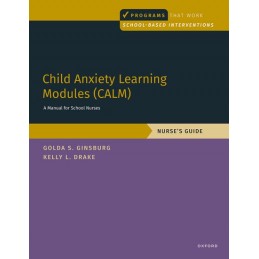
Excessive anxiety among elementary age students is common, yet less than half of children with anxiety receive the services they need to succeed in school. This service gap could be filled by expanding the network of providers who can assist students with anxiety. Because physical symptoms, such as headaches and stomachaches, are a hallmark feature of excessive anxiety, school nurses are often the first school-based personnel to identify a student with anxiety who needs support.Child Anxiety Learning Modules (CALM) provides a brief and practical program to help students struggling with anxiety. Based on cognitive behavioral strategies that are effective in reducing anxiety, the CALM program was developed by the authors for elementary school nurses and is designed to be delivered to individual students in five 20-30 minute meetings with an additional optional parent meeting. This manual provides a step-by-step guide to carry out the CALM program, includingdetailed instructions on how to teach anxiety reduction strategies, sample scripts, and student-friendly handouts to be used during each meeting. As a comprehensive book, it will provide school nurses with the foundational information and strategies they need to assist students with anxiety in an integrated,organized, consumable format.
Part 1: Introductory Information for School Nurses; Chapter 1: Purpose of the CALM Program and the Role of School Nurses; Chapter 2: Background Information on Pediatric Anxiety; Chapter 3: Description and Empirical Support of the CALM Program; Chapter 4: Getting Started With the CALM Program; Part 2: The CALM Meetings; Chapter 5: Getting Parents Involved; Chapter 6: CALM Meeting 1: Psychoeducation; Chapter 7: CALM Meeting 2: C = Calm Down by Learning Relaxation Strategies; Chapter 8: CALM Meeting 3: A = Actions That Will Reduce Anxiety (i.e., Facing Fears); Chapter 9: CALM Meeting 4: L = Listen to Scary Thoughts and Change Them Into Coping Thoughts; Chapter 10: CALM Meeting 5: M = Manage Future Problems; Part 3: Troubleshooting and Resources; Chapter 11: Troubleshooting Guide and Additional Resources; Bibliography; List of Handouts;
Comments (0)
Your review appreciation cannot be sent
Report comment
Are you sure that you want to report this comment?
Report sent
Your report has been submitted and will be considered by a moderator.



 Delivery policy
 Security policy
 Return policy