- Reduced price
- New

Order to parcel locker

easy pay

 Delivery policy
Choose Paczkomat Inpost, Orlen Paczka, DHL, DPD or Poczta Polska. Click for more details
 Security policy
Pay with a quick bank transfer, payment card or cash on delivery. Click for more details
 Return policy
If you are a consumer, you can return the goods within 14 days. Click for more details
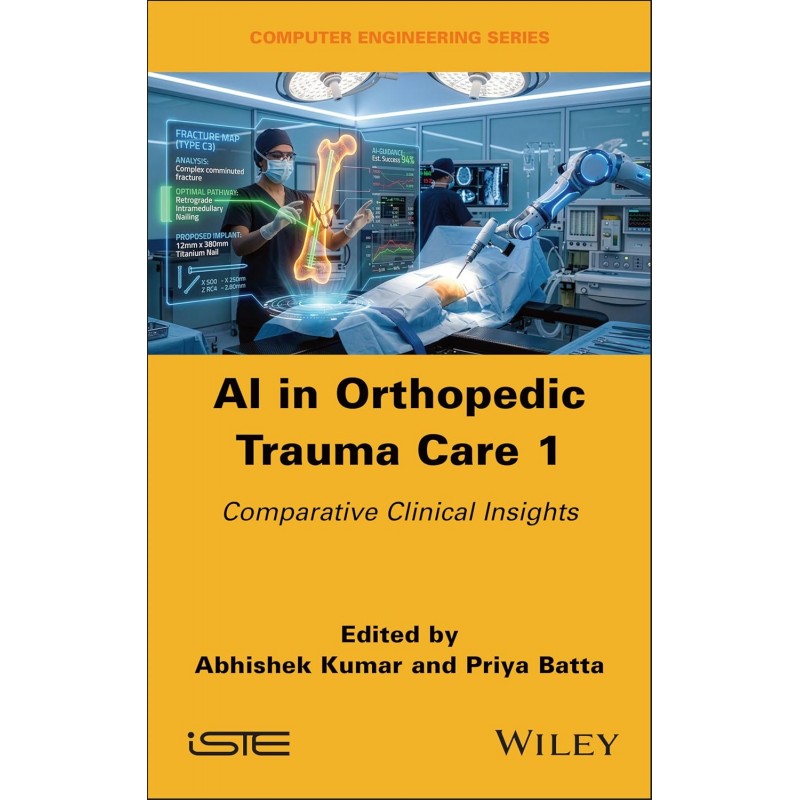
AI in Orthopedic Trauma Care 1 explores how AI technologies are transforming comparative clinical decision-making in orthopedic trauma. Positioned within precision healthcare, this book shows how AI-assisted analytics enhance the evaluation of surgical techniques and treatment strategies.
Integrating machine learning, deep learning, medical imaging analytics, wearable sensor data and electronic health records, this book applies data-driven methods to compare fixation approaches, operative techniques, graft choices and pharmacological interventions. Emphasis is placed on outcome analysis, optimized treatment selection, continuous monitoring and complication reduction through structured clinical pathways.
By combining orthopedic expertise with advanced computational tools, this book offers practical insights for clinicians, healthcare technologists and researchers advancing patient-centered, AI assisted trauma care.
Data sheet
Preface xi
Abhishek KUMAR and Priya BATTA
Chapter 1. AI-Assisted Comparison of Volar Plating with and Without Carpal Tunnel Release in Distal Radius Fractures 1
Abhishek SHARMA and Paresh V. PATIL
1.1. Introduction 2
1.2. Literature review 4
1.3. Materials and methods 6
1.3.1. Study setting and ethical approval 6
1.3.2. Study population and sample size 6
1.3.3. Inclusion criteria 7
1.3.4. Exclusion criteria 7
1.3.5. Study Groups 8
1.3.6. Preoperative assessment 8
1.3.7. Trauma-surgery interval 8
1.3.8. Observation and result 9
1.4. Discussion 18
1.5. Conclusion 20
1.6. References 20
Chapter 2. Trigger Digits: Steroid Injection Versus Percutaneous Release Using AI-Based Outcome Analysis 23
Anshuraj JAGDALE and Jineshwar S. KAPALE
2.1. Introduction 23
2.2. Literature review 26
2.3. Conservative management: LSI 27
2.4. PR: technique and outcomes 27
2.5. Comparative efficacy: steroid injection versus PR. 28
2.6. Complications and safety considerations 29
2.7. Meta-analyses and systematic reviews 29
2.8. Clinical implications and future directions 29
2.9. Materials and methods 30
2.9.1. Materials and method of selection 30
2.9.2. Conduction of study 30
2.9.3. Sample size 31
2.9.4. Statistical analysis 32
2.10. Observation and results 32
2.10.1. Age distribution 32
2.10.2. Sex distribution 33
2.10.3. Side distribution 34
2.10.4. Pre-operative analysis of Greens grading 34
2.10.5. Finger involvement 35
2.10.6. Efficacy of treatment modalities 36
2.10.7. Recurrence rate post-treatment 37
2.10.8. Longevity of symptom relief within the follow-up period 38
2.10.9. Tendon release assessment in the PR group 39
2.11. Complications 40
2.11.1. Tendon/neurovascular bundle injury 40
2.11.2. Infection rate 41
2.11.3. Post-treatment functional outcome assessment 41
2.12. Discussion 42
2.13. Conclusion 43
2.14. References 44
Chapter 3. Rigid Versus Hybrid Fixation in Both-Bone Forearm Fractures: An AI-Supported Comparative Study 47
Manthena Ramakrishna Vittal VERMA and Paresh V. PATIL
3.1. Introduction 47
3.2. Literature review 49
3.2.1. Evolution of forearm fracture management 49
3.2.2. Rigid fixation using plate osteosynthesis 50
3.2.3. IMN of forearm bones 50
3.2.4. Hybrid fixation: concept and rationale 51
3.2.5. Comparative studies: rigid versus hybrid fixation 51
3.2.6. Functional outcomes and complications 51
3.2.7. Role of advanced and AI-assisted analysis 52Contents vii
3.3. Materials and methods 52
3.3.1. Duration of study 52
3.3.2. Ethical approval 53
3.3.3. Study population 53
3.3.4. Inclusion criteria 53
3.3.5. Sample size 54
3.3.6. Observation and results 55
3.4. Discussion 66
3.5. Conclusion 67
3.6. References 68
Chapter 4. Fracture Healing After Cephalomedullary Nailing with Zoledronic Acid: An AI-Driven Comparison 71
Mrunal PATEL and Pradeep N. KULKARNI
4.1. Introduction 71
4.2. Literature review 74
4.2.1. CMN and fracture healing 74
4.2.2. BPs and fracture healing 74
4.2.3. Mechanisms of ZA in bone healing 75
4.2.4. Clinical implications for CMN with ZA 76
4.2.5. AI-driven comparative approaches in orthopedic outcomes 76
4.3. Materials and methods 77
4.3.1. Sample size 77
4.3.2. Enrolment criteria 78
4.3.3. Study tool 78
4.4. Observation and results 79
4.4.1. AO Type 2 (comminuted, non-articular) 86
4.5. Discussion 90
4.6. Conclusion 91
4.7. References 91
Chapter 5. Alpha-Blockers in Cervical Radiculopathy: An AI-Guided Efficacy Study 95
Nidhi Vipul SHAH and Pradeep N. KULKARNI
5.1. Introduction 95
5.2. Literature review 97
5.2.1. Cervical radiculopathy: epidemiology and etiology 97
5.2.2. Pathophysiology of cervical radiculopathy 98
5.2.3. Clinical presentation and diagnostic approaches 98
5.2.4. Conventional treatment modalities – NSAIDs 99
5.2.5. Cervical traction 99
5.2.6. Interventional pain management techniques 99
5.2.7. Epidural steroid injections and selective nerve root blocks 99
5.2.8. Physiological pain portal block (Alpha Portal Block) 100
5.2.9. Alpha Portal Block in cervical radiculopathy 100
5.2.10. Role of AI in outcome analysis 100
5.3. Materials and methods 101
5.3.1. Sample size calculation (explained) formula used 101
5.3.2. Exclusion criteria 101
5.4. Observation and results 102
5.5. Discussion 107
5.6. Conclusion 108
5.7. References 109
Chapter 6. Suprapatellar Versus Infrapatellar Tibial Nailing: AI-Assisted Outcome Comparison 113
Nikhil DUDHANI and Nitin S. PATIL
6.1. Introduction 114
6.2. Literature review 116
6.2.1. Epidemiology and management of tibial shaft fractures 116
6.2.2. IP tibial nailing 116
6.2.3. SP tibial nailing 117
6.2.4. Comparative studies: SP versus IP approach 117
6.2.5. Role of AI in orthopedic outcome analysis 118
6.3. Materials and methods 118
6.3.1. Study design 118
6.3.2. Study setting 119
6.3.3. Study duration 119
6.3.4. Inclusion criteria 119
6.3.5. Exclusion criteria 119
6.4. Observation and results 120
6.5. Discussion 127
6.6. Conclusion 128
6.7. References 129
Chapter 7. AI-Based Functional Outcome Comparison of Nails in Unstable Intertrochanteric Femur Fracture. 133
Chintalapuri Pranay Bhargav REDDY and Vikash A. SATRE
7.1. Introduction 133
7.2. Literature review 136
7.3. Materials and methods 138
7.3.1. Study configuration and design 138
7.3.2. Quantity of the sample 138Contents ix
7.3.3. Sampling method 139
7.3.4. Inclusion criteria 139
7.3.5. Exclusion criteria 140
7.3.6. Ethical considerations 140
7.3.7. Surgical procedure 140
7.4. Observation and results 140
7.4.1. Age distribution 140
7.5. Discussion 147
7.6. Conclusion 148
7.7. References 149
Chapter 8. Dynamic Condylar Screw Versus Long PFN in Subtrochanteric Fractures: An AI-Enhanced Study 153
Rutul D. PATEL and Nitin S. PATIL
8.1. Introduction 154
8.2. Literature review 156
8.2.1. Subtrochanteric femur fractures 156
8.2.2. Evolution of surgical management 156
8.2.3. DCS 157
8.2.4. LPFN 157
8.2.5. Comparative studies: DCS versus long PFN 157
8.2.6. The role of AI in fracture outcome analysis 158
8.3. Materials and methods 158
8.3.1. Study design 158
8.3.2. Ethical approval 158
8.3.3. Study duration 159
8.3.4. Sample size 159
8.4. Observation and results 160
8.5. Discussion 170
8.6. Conclusion 171
8.7. References 172
Chapter 9. Mid-Shaft Humerus Fractures: AI-Supported Comparison of Fixation Methods 175
Syed Nadeem AHAMED and Jineshwar S. KAPALE
9.1. Introduction 175
9.2. Literature review 178
9.2.1. Operative fixation: overview and evolution 178
9.2.2. Comparative evidence: plating versus nailing 179
9.2.3. Minimally invasive plating and bridge techniques 180
9.2.4. Functional outcomes and patient-reported measures 180
9.2.5. Complications and risk profiles 180
9.2.6. Current gaps and future directions 180
9.3. Materials and methods 181
9.3.1. Study design 181
9.3.2. Study site 181
9.3.3. Study duration 181
9.3.4. Sample size calculation 182
9.3.5. Sample size of approximately 35 for each group 182
9.3.6. Exclusion criteria 183
9.3.7. Surgical procedures 183
9.4. Observation and results 183
9.5. Discussion 191
9.6. Conclusion 192
9.7. References 192
Chapter 10. ACL Reconstruction Using Peroneus Longus Versus Hamstring Graft: An AI-Based Outcome Study 195
Viradraj Shrinivas DESHMUKH and Nishant GAONKAR
10.1. Introduction 195
10.2. Literature review 198
10.2.1. HT graft 199
10.2.2. Flap of PLT grafts 199
10.2.3. Comparative studies between PL and hamstring grafts 199
10.2.4. Application of AI in outcome evaluation 200
10.3. Materials and methods 200
10.3.1. Study design 200
10.3.2. Sample size calculation. 200
10.3.3. Sample selection and randomization 202
10.3.4. Methods of data collection. 203
10.4. Observation and results 203
10.5. Discussion 210
10.6. Conclusion 211
10.7. References 211
List of Authors 215
Index 219
Reference: 105019
Author: Abhishek Kumar