- Reduced price

Order to parcel locker

easy pay

 Delivery policy
Choose Paczkomat Inpost, Orlen Paczka, DHL, DPD or Poczta Polska. Click for more details
 Security policy
Pay with a quick bank transfer, payment card or cash on delivery. Click for more details
 Return policy
If you are a consumer, you can return the goods within 14 days. Click for more details
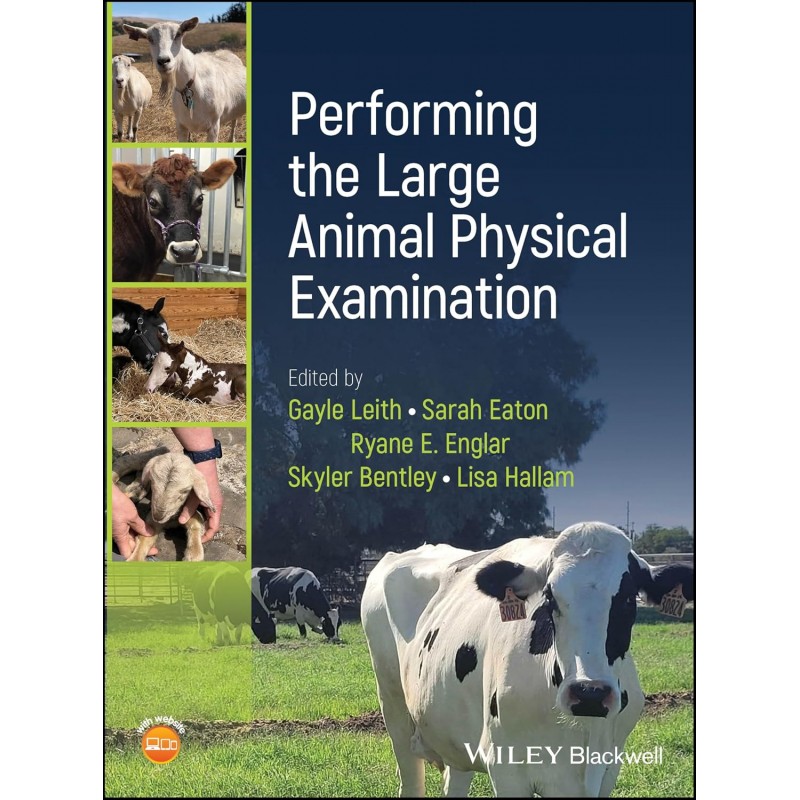
Featuring hundreds of full-color images demonstrating the observation and hands-on clinical skills described, Performing the Large Animal Physical Examination offers a step-by-step guide to all aspects of assessing the health and wellbeing of equine patients and ruminants. Cattle, sheep, and goats are emphasized, with vital commentary about camelids included when applicable.
Each section begins with information on observing, approaching, and safely handling patients, then discusses how to systematically evaluate each body system. A companion website features video clips demonstrating key concepts.
Performing the Large Animal Physical Examination includes information on::
Performing the Large Animal Physical Examination is an essential resource for students and other veterinary team members to develop comfort and confidence observing, approaching, handling, and examining equine and ruminant patients, as well as for experienced practitioners who may wish to refine their skills and clinical acumen.
Data sheet
Contributor Names and Affiliations xx
About the Editors xxiii
Preface xxvii
Acknowledgments xxviii
About the Companion Website xxix
Part I Performing the Physical Examination of Horses 1
1 Setting the Stage: Observing and Understanding Equine Behavior 3
Gayle Leith and Ryane E. Englar
2 Safe Methods by Which to Approach and Restrain the Equine Patient 17
Gayle Leith and Ryane E. Englar
3 Assessing the Big Picture: The Equine Body, Skin, Coat, Coat Colors, and Markings 42
Gayle Leith and Ryane E. Englar
4 Examining the Head, with Emphasis on the Eyes and Ears 99
Gayle Leith and Ryane E. Englar
5 Examining the Cardiovascular, Respiratory, and Lymphatic Systems of the Equine Patient 138
Gayle Leith and Ryane E. Englar
6 Examining the Alimentary Tract of the Equine Patient 173
Gayle Leith and Ryane E. Englar
7 Equine Musculoskeletal and Lameness Exams 203
Lara Shreve
8 Examining the Nervous System of the Horse 226
Gayle Leith and Ryane E. Englar
9 The Reproductive Exam in the Mare 252
Sarah Eaton
10 The Reproductive Exam in the Gelding and Stallion 272
Sarah Eaton
11 Examination of the Neonate 284
Sarah Eaton
12 Basic Clinical Procedures in Equine Practice 301
Gayle Leith, Sarah Eaton, and Ryane E. Englar
13 Indications for Referral in Equine Practice 357
Gayle Leith and Ryane E. Englar
Part II Performing the Physical Examination of Ruminants 369
14 Setting the Stage: Observing and Understanding Ruminant Behavior 371
Skyler Bentley and Shaun Huser
15 Safe Methods by Which to Approach and Restrain Ruminants 392
Skyler Bentley and Shaun Huser
17 Examining the Head of the Ruminant, with Emphasis on the Eyes, Ears, Nose, Mouth, and Throat 419
Brian M. Shoemake and Dusty W. Nagy
18 Examining the Cardiovascular and Respiratory Systems of the Ruminant 445
Leslie Weaver and Bryan Weaver
19 Examining the Lymphatic System of the Ruminant 455
Leslie Weaver and Bryan Weaver
20 Examination of the Ruminant Digestive System 461
21 Examining the Musculoskeletal System of Ruminants 483
Brian M. Shoemake and Dusty W. Nagy
22 Examining the Nervous System of the Ruminant 503
Dusty W. Nagy and Brian M. Shoemake
23 The Reproductive Exam in the Cow, Ewe, Doe, and Female South American Camelid 518
Jennifer H. Koziol DVM, MS, DACT
24 The Reproductive Exam in the Bull, Ram, Buck, and South American Camelid Stud 529
Jennifer H. Koziol DVM, MS, DACT
25 Examination of the Neonate 537
Dusty W. Nagy and Brian M. Shoemake
26 Clinical Diagnostic Procedures in Ruminants 550
Philippa (Pippa) Gibbons
27 Indications for Referral 575
Bryan Weaver and Leslie Weaver
Index 581