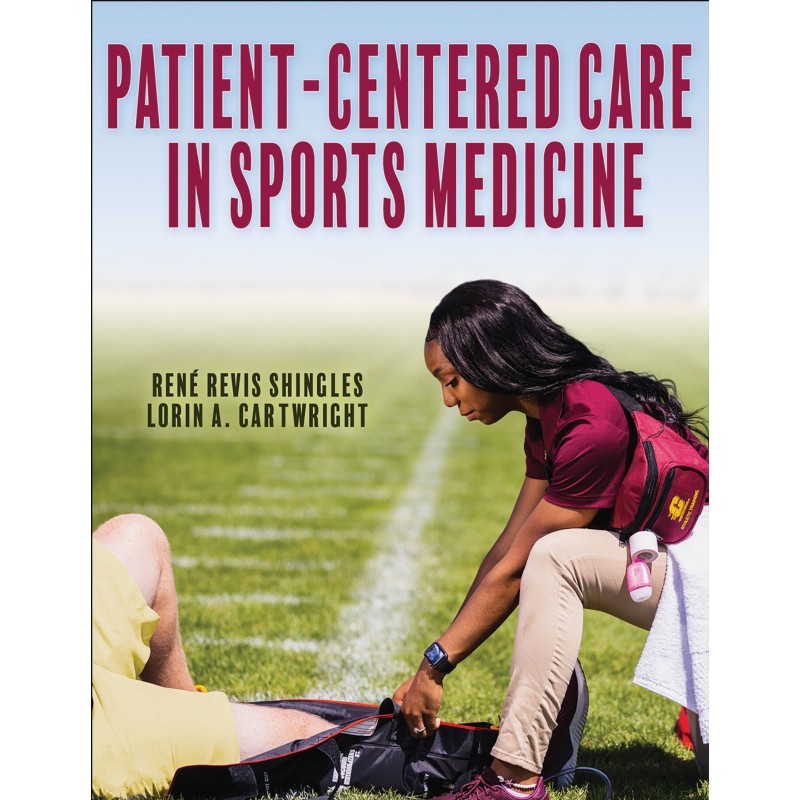
It is essential that students entering health care professions be well informed about the social determinants of health and be equipped with strategies to advocate for, engage with, and communicate with patients from a variety of backgrounds. For educators, Patient-Centered Care in Sports Medicine is aligned with the Patient-Centered Care core competency outlined by the Commission on Accreditation of Athletic Training Education (CAATE), and it prepares students to put patient-centered care into practice as they work with diverse individuals.
Patient-Centered Care in Sports Medicine defines patient-centered care, explains its importance for every patient interaction, and shows how to model patient-centered care in daily practice. Students will come to better understand how social identities related to race, class, gender, and sexuality shape the patient-health care provider relationship, as well as how a providers own social identities may influence the care they provide. Self-assessment tools will help students evaluate their personal stereotypes, implicit biases, and prejudices, while patient-centered communication models provide guidance on eliciting crucial information from patients to make sure their needs are addressed.
The second half of the book offers invaluable knowledge about the largest cultural groups within the United States, the LGBTQIA+ community, and individuals with disabilities. For each culture, the discussion addresses cultural information such as primary languages and communication styles, family structure, daily living and food practices, and more. This rich discussion allows students to build cultural awareness for use in their future careers.
Throughout the text, chapter objectives, review questions, case studies, and key terms help students comprehend and retain the information presented. Athletic Training Professionals in Their Own Words sidebars feature noted athletic trainers discussing their experiences in various settings. Forms that are beneficial in health care settings-including a satisfaction survey, a facility checklist, and sample policies and procedures-are provided in the book.
Patient-Centered Care in Sports Medicine serves as an excellent guide for institutions and individual providers who desire to become more competent when working with athletes or patients from a variety of backgrounds.
Chapter 1. Defining Patient-Centered Care What Is Patient-Centered Care? Frameworks of Patient-Centered Care Why Is Patient-Centered Care Important? Terminology and Language Summary
Chapter 2. Demographics, Social Determinants of Health, and Health Disparities What Are Health Disparities? Changing Demographics Social Determinants of Health Relationship Between Demographics, Social Determinants of Health, and Health Disparities Reducing Health Disparities A Social Justice Lens: Advocating for Patients Summary
Part II. Patient-Centered Awareness
Chapter 3. Understanding Difference Unpacking the Luggage Repacking the Luggage Summary
Chapter 4. Understanding Oneself Cultural Awareness and Self-Assessment Everyone Has Culture Generalizations, Stereotypes, Prejudices, and Implicit Bias Microagressions : Microassaults, Microinsults, Microinvalidations, and Environmental Microaggressions Advantages, Disadvantages, and Privileges Summary
Part III. Patient-Centered Communication
Chapter 5. Eliciting Information The Explanatory Models Approach, Outline for Cultural Formulation, and Cultural Formulation Interview Other Models for Eliciting Information Eliciting Information Through Use of an Interpreter Patient Forms and Data Gathering Summary
Chapter 6. Patient-Centered and Culturally Based Physical Assessment Taking an Oral History Inspecting and Observing Physical Signs Palpating Summary
Chapter 7. Patient and Family Engagement Framework for Patient and Family Engagement Factors That Influence Patient and Family Engagement Strategies for Addressing Barriers to Engagement Summary
Chapter 8. Introducing Patient-Centered Care in the Athletic Training Facility Implementing Patient-Centered Care Implementation Considerations Summary
Part IV. Patient-Centered Knowledge
Chapter 9. Native Americans American Indians Native Alaskans Summary
Chapter 10. Asian Americans and Pacific Islander Americans Chinese Americans Indian Americans Filipino Americans Summary
Chapter 15. Lesbian, Gay, Bisexual, Transgender Americans Overview and Framework Historical Perspectives Demographic Characteristics Cultural and Psychosocial Challenges Coming Out or Inviting In Lesbian Gay Bisexual Transgender Summary
Chapter 16. Americans With Disabilities Limb Deficiencies Deaf or Hard of Hearing Blindness or Limited Vision Summary
Appendix A. Satisfaction Survey Appendix B. Patient-Centered Athletic Training Facility Guidelines and Checklist Appendix C. Sample Policies and Procedures Appendix D. Religious and Spiritual Orientations
Comments (0)
Your review appreciation cannot be sent
Report comment
Are you sure that you want to report this comment?
Report sent
Your report has been submitted and will be considered by a moderator.




 Delivery policy
 Security policy
 Return policy