- Reduced price
- New

Order to parcel locker

easy pay

 Delivery policy
Choose Paczkomat Inpost, Orlen Paczka, DHL, DPD or Poczta Polska. Click for more details
 Security policy
Pay with a quick bank transfer, payment card or cash on delivery. Click for more details
 Return policy
If you are a consumer, you can return the goods within 14 days. Click for more details
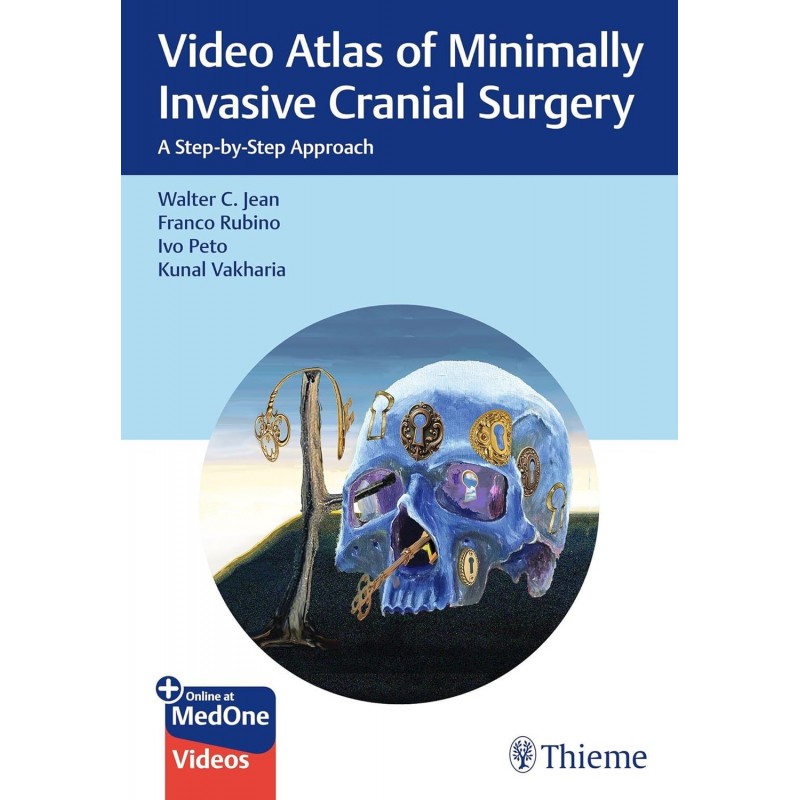
An insightful video guide to minimally invasive cranial surgery from renowned global pioneers
During the last three decades, minimally invasive cranial (keyhole) surgery has proven to be an effective and safe approach that reduces postoperative patient recovery time and pain. Yet, aside from endoscopic endonasal surgery, a transcranial subset of procedures is not taught as standard practice in the majority of training programs around the world. Video Atlas of Minimally Invasive Cranial Surgery:: A Step-by-Step Approach by minimally invasive neurosurgery experts Walter C. Jean, Franco Rubino, Ivo Peto, and Kunal Vakharia underscores the importance of incorporating groundbreaking approaches in the standard repertoire of contemporary neurosurgery and modernizing its teaching.
The book is organized by nine cranial regions, encompassing the orbit, sella/parasellar, anterior cranial fossa/circle of Willis, third ventricle, pineal, petrous apex, infratemporal fossa, retrosigmoid/lateral suboccipital, and clivus and craniocervical, followed by Part 10 that covers supratentorial approaches. Each of the chapters is consistently formatted with an introduction, followed by pertinent anatomy, brief case discussions with accompanying videos, operative setups, approach selection, exposure, key steps, and potential risks and avoidance strategies.
Key Highlights
This unique resource provides a significant contribution to the advancement of MINS. It is an essential reference for every neurosurgery resident, fellow, and practitioner who is interested in furthering the ongoing evolution of MINS and standard of care in the field.
This print book includes a scratch off code to access a complimentary digital copy on MedOne.
Publishers Note:: Products purchased from Third Party sellers are not guaranteed by the publisher for quality, authenticity, or access to any online entitlements included with the product.
Data sheet
1 Mini-pterional: How Mini is too Mini and the Next Generation of Keyholes
Part I: Approach Involving the Orbit
2 Endoscopic Supraorbital Approach
3 Endoscopic Transorbital Approach to the Anterior Clinoid
4 Endoscopic Transorbital Approach to the Cavernous Sinus and Meckels Cave
5 Endoscopic Approach for Cerebrospinal Fluid Leak Repair
Part II: Approach to the Sella/Parasellar
6 Endoscopic Endonasal Approach to the Sella Turcica
7 Endoscopic Transsphenoidal Approach/Medial Wall of the Cavernous Sinus
8 Endoscopic Approach to Meckels Cave
Part III: Approach to the Anterior Cranial Fossa/Circle of Willis
9 Endoscopic Endonasal Transcribriform/Transplanum Approach
10 Endoscopic Endonasal Transtuberculum Approach for Tuberculum Sellae Meningioma
11 Endoscopic Endonasal Approach for Optic Nerve Decompression and Tuberculum Sellae Meningioma
12 Transfrontal Sinus Keyhole Approach with Gull Wing Incision
13 Lateral Supraorbital Approach
14 The Mini-pterional Approach and Clinoidectomy
Part IV: Approaches to the Third Ventricle
15 Endoscopic Endonasal Approach for Craniopharyngioma
16 Endoscopic Resection of Colloid Cyst
17 The Mini-Transcallosal Approach to the Third Ventricle
Part V: Approaches to the Pineal Region
18 Endoscopic Paramedian Supracerebellar Infratentorial Approach
19 Keyhole for Combined Pineal Biopsy and Third Ventriculostomy
Part VI: Approaches to Petrous Apex
20 Endoscopic Transpterygoid Translacerum Approach to the Petrous Apex
21 Endoscopic Endonasal Transpterygoid Approaches to the Cavernous Sinus
22 The Mini-Anterior Petrosectomy
23 The Mini Combined Transpetrosal Approach
Part VII: Approaches to Infratemporal Fossa
24 Endoscopic Endonasal Approach to the Infratemporal Fossa
Part VIII: Approaches to the Retrosigmoid/Lateral Suboccipital Region
25 Minimally Invasive Retrosigmoid Intradural Suprameatal Approach
26 Endoscopic-Assisted Retrosigmoid Transmeatal Approach for Vestibular Schwannoma
27 Endoscopic Microvascular Decompression
Part IX: Approaches to the Clivus and Craniocervical Region
28 Endoscopic Far-Medial Approach
29 Endoscopic Transclival Approach
30 Endoscopic Approach to the Fourth Ventricle
Part X: Supratentorial Approaches
31 Contralateral Transfalcine Approach
32 Tubular Transcortical Approaches
33 Minimally Invasive Selective Amygdalohippocampectomy for Epilepsy
34 Paramedian Supracerebellar Transtentorial Approach for Selective Amygdalohippocampectomy
Reference: 102729
Author: Alan L Buchman
Reference: 103584
Author: Laura Prager