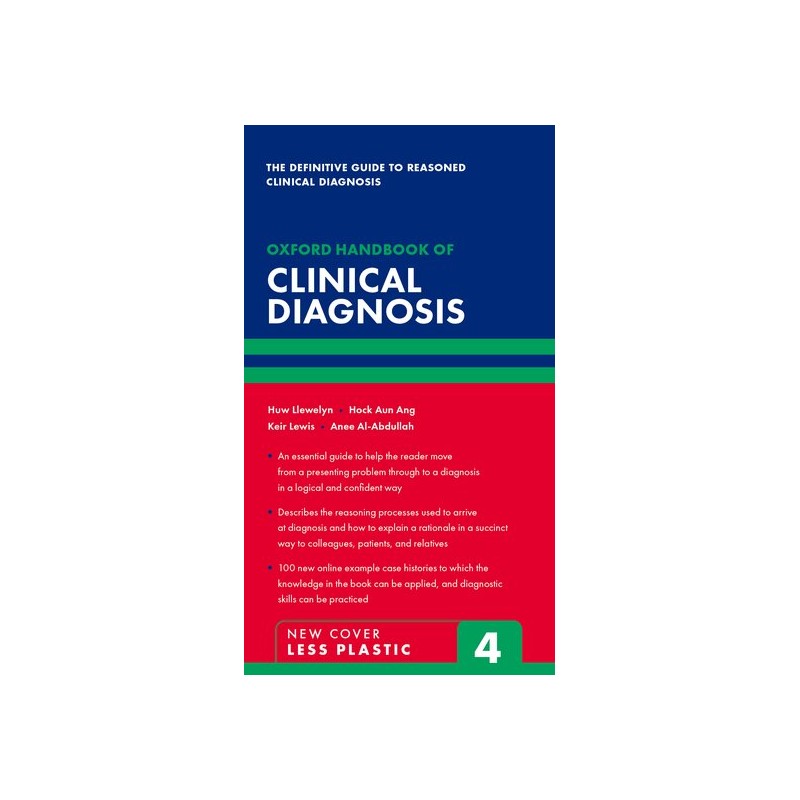
The Oxford Handbook of Clinical Diagnosis, Fourth Edition, is a leading guide to help the medical trainee move from a presenting problem to a well-reasoned diagnosis. It also describes how to explain such a rationale clearly and confidently to other doctors, examiners, and also patients and relatives. This ground-breaking, and practical handbook identifies the possible results of the history, preliminary tests, and examination that can be used as a lead with a manageable list of differential diagnoses. Combinations of findings can then be found in succinctly worded tables that can be scanned quickly for a diagnosis compatible with the patients findings, and the presenting complaints. Readers can also test what they have learnt by hiding parts of the tables before trying to recall thedifferential diagnoses and confirmatory findings. This flexible approach is different to that of starting with one broad finding (e.g. chest pain) and being led through a long list of diagnostic possibilities displayed by fixed flow charts. The book concludes with a chapter that analyses traditionaldiagnostic reasoning in great detail, and how it can use modern technology.This fully revised fourth edition is aimed primarily at medical students and resident doctors who wish to improve their diagnostic skills and is now accompanied by 100 online example case histories to which the knowledge in the book can be applied, and diagnostic skills can be practiced. It provides all doctors with a rapid, succinct revision source and practical help when dealing with undifferentiated problems outside their immediate field of expertise. It also provides more senior doctorswith examples, and a framework to help teach trainees to approach diagnostic problems logically, and to justify their opinions in a structured way. This can avoid breakdowns in communication that are so common in todays multi-disciplinary care.
The diagnostic process; Interpreting the history and examination; General and endocrine symptoms and physical signs; Skin symptoms and physical signs; Cardiovascular symptoms and physical signs; Respiratory symptoms and physical signs; Gastrointestinal symptoms and physical signs; Urological and gynaecological symptoms and physical signs; Joint, limb, and back symptoms and physical signs; Psychiatric and neurologi-cal symptoms and physical signs; Laboratory test results; Chest X-rays; Making the diagnostic process evidence-based;
Comments (0)
Your review appreciation cannot be sent
Report comment
Are you sure that you want to report this comment?
Report sent
Your report has been submitted and will be considered by a moderator.



 Delivery policy
 Security policy
 Return policy