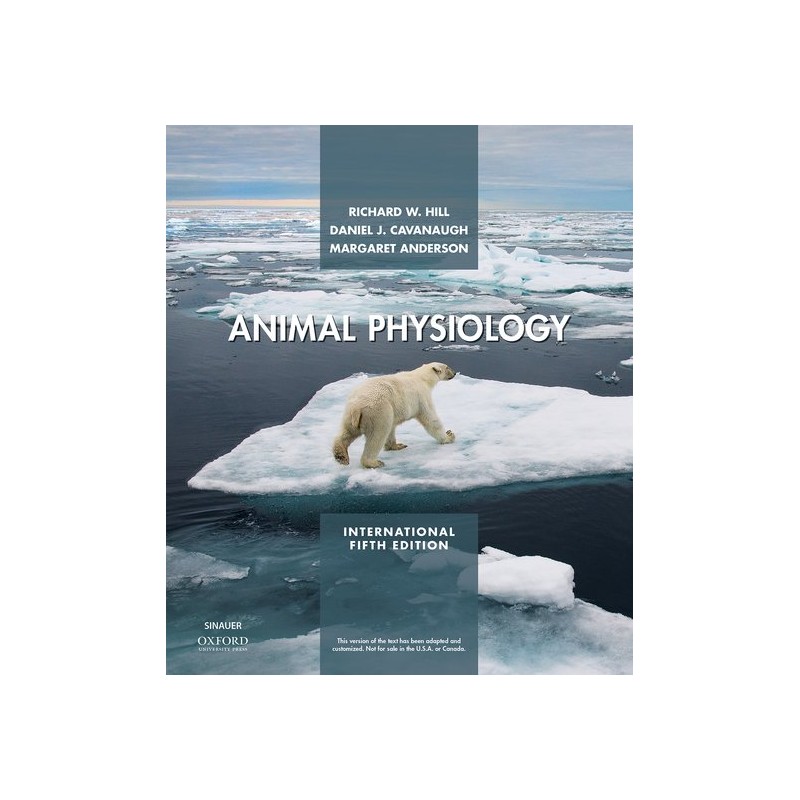
Comprehensive, contemporary, and engaging, Animal Physiology provides evolutionary and ecological context to help students make connections across all levels of physiological scale. One of the major challenges instructors and students face in Animal Physiology is making connections across levels of biological scale. Animal Physiology addresses this challenge by providing ecological and evolutionary context to the study of physiology at all levels of organization:: genome, molecularbiology, biochemistry, cells, tissues, organs, and organ systems. Hills inclusion of ecology and evolution helps readers gain a holistic perspective on animal function and sets Animal Physiology apart from texts that focus more narrowly on physiology. Hills Animal Physiology is trusted byinstructors and students because of its authoritative, current, engaging, and lavishly illustrated presentation.
Preface; Part I Fundamentals of Physiology; Chapter 1 Animals and Environments: Function on the Ecological Stage; Chapter 2 Molecules and Cells in Animal Physiology; Chapter 3 Genomics, Proteomics, and Related Approaches to Physiology; Chapter 4 Physiological Development and Epigenetics; Chapter 5 Transport of Solutes and Water; Part II Food, Energy, and Temperature; Chapter 6 Nutrition, Feeding, and Digestion; Chapter 7 Energy Metabolism; Chapter 8 Aerobic and Anaerobic Forms of Metabolism; Chapter 9 The Energetics of Aerobic Activity; Chapter 10 Thermal Relations; Chapter 11 Food, Energy, and Temperature AT WORK: The Lives of Mammals in Frigid Places; Part III Integrating Systems; Chapter 12 Neurons; Chapter 13 Synapses; Chapter 14 Sensory Processes; Chapter 15 Nervous System Organization and Biological Clocks; Chapter 16 Endocrine and Neuroendocrine Physiology; Chapter 17 Reproduction; Chapter 18 Integrating Systems AT WORK: Animal Navigation; Part IV Movement and Muscle; Chapter 19 Control of Movement; Chapter 20 Muscle; Chapter 21 Movement and Muscle AT WORK: Plasticity in Response to Use and Disuse; Part V Oxygen, Carbon Dioxide, and Internal Transport; Chapter 22 Introduction to Oxygen and Carbon Dioxide in Physiology; Chapter 23 External Respiration: The Physiology of Breathing; Chapter 24 Transport of Oxygen and Carbon Dioxide in Body Fluids (with an Introduction to Acid-; Base Physiology); Chapter 25 Circulation; Chapter 26 Oxygen, Carbon Dioxide, and Internal Transport AT WORK: Diving by Marine Mammals; Part VI Water, Salts, and Excretion; Chapter 27 Water and Salt Physiology: Introduction and Mechanisms; Chapter 28 Water and Salt Physiology of Animals in Their Environments; Chapter 29 Kidneys and Excretion (with Notes on Nitrogen Excretion); Chapter 30 Water, Salts, and Excretion AT WORK: Mammals of Deserts and Dry Savannas; Appendix A The Syst?me International and Other Units of Measure; Appendix B Prefixes Indicating Orders of Magnitude; Appendix C Gases at Standard Temperature and Pressure; Appendix D Logarithms; Appendix E Exponential and Allometric Equations; Appendix F Phylogenetically Independent Contrasts; Appendix G The Standard Amino Acids; Appendix H Basic Physics Terms; Appendix I Summary of Major Bloodborne Hormones in Mammals; digital version/online only:; Appendix J Fitting Lines to Data; Appendix K Mitosis and Meiosis; Glossary; Index;





 Dostawa
 Płatność
 Zwroty