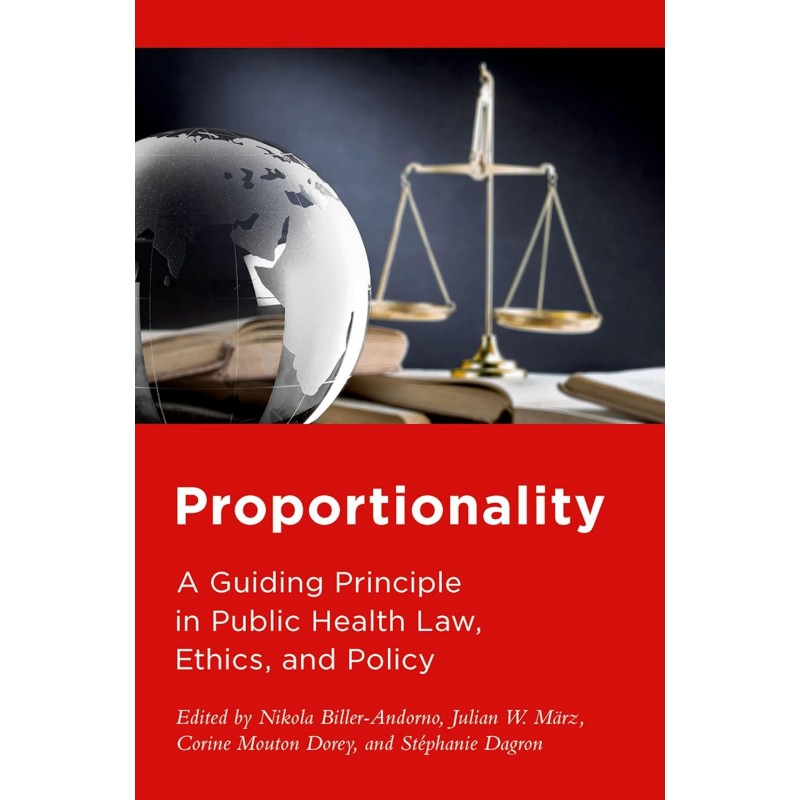
This is an open access title available under the terms of a CC BY-NC-ND 4.0 International licence. It is free to read on the Oxford Academic platform and offered as a digital version download from OUP and selected open access locations.During crises, such as pandemics or environmental disasters, governments must act swiftly to prevent disease and death, often with incomplete information. The principle of proportionality serves as the established legal and ethical standard for navigating this balance. However, during times of severe crisis and uncertainty, determining the proportionality of public health actions is extremely complex, particularly when decisions are made without conclusive evidence or uniformly applicableinternational standards.In Proportionality, Nikola Biller-Andorno, Julian W. März, Corine Mouton-Dorey, and Stephanie Dagron bring together 49 scholars and practitioners from around the world to explore how proportionality can guide and shape decision-making under crisis conditions. As they argue, a fundamental challenge in this domain is reconciling the obligation to foster population health through disease prevention, detection, and intervention with the imperative to respect and protectindividual rights, including autonomy and privacy. Thus, the chapters in this volume highlight the principle and the process of proportionality, in order to guide decision-making and apply proportionate measures in the face of future public health crises, whether infectious, ecological, or linked to armed conflict. This volumenot only develops the key concept of proportionality from the perspectives of law, human rights, philosophy, public health ethics, and political science, but it also looks at specific proportionality issues, such as freedom of movement, gender equity, childrens rights and disease prevention.Examining how governments and health authorities navigate the delicate balance between protecting public health and safeguarding individual rights in times of crisis, Proportionality provides a comprehensive analysis on the topic. Further, it aims to guide the development of public health policies that are effective, equitable, and respectful of human rights.
Introduction; Proportionality and Uncertainty in Physical Distancing Policies in US States; Proportionality and Resource Allocation in a Pandemic: The Example of Chile; Proportionality in Public Health Ethics, Fear, and State of Exception: A Critical Narrative Approach; Perceptions of Proportionality: An Empirical Study of Swiss Residents Moral Considerations about COVID-19 Containment Measures; Proportionality and the Need for Evidence: A Case Study of Outdoor Public Health Interventions for Respiratory Viruses in Australia; Inaction and the Proportionality Principle: A Review of the Management of the COVID-19 Pandemic in Mexico; Public Health Proportionality for Sexual and Gender Minority Youth; Responding Proportionately to the COVID-19 Pandemic in UK Long-Stay Inpatient Pediatric Wards; Proportionality in Public Health Law: A Case Study of Singapores Travel Restrictions for Migrant Healthcare Workers; COVID-19 Restrictions in Long-Term Care Facilities in the United States: Unintended Consequences and Possible Lessons; Proportionality Behind Locked Doors: Nursing Homes, Fundamental Rights, and Visit Restrictions During the Coronavirus Pandemic; Mobile Vaccination Teams in Long-Term Care Homes for the Elderly in Germany During the COVID-19 Pandemic; Proportionality of the COVID-19 Measures: The European Court of Human Rights Approach; Proportionality and the Swiss Courts; The Right to Privacy, Contact Tracing, and Public Health During the COVID-19 Pandemic: The Israeli Case; The Principle of Proportionality and the Digitalization of Epidemic Countermeasures in Hong Kong Special Administrative Regions; Proportionality, Epidemiological Research, and Data Protection in a Pandemic; (Dis)proportionate Abortion Care Regulation and the COVID-19 Pandemic in Great Britain; A Proportional Response?: Abortion Exceptionalism, Telemedicine, and the COVID-19 Pandemic in Great Britain;
Komentarze (0)
Chwilowo nie możesz polubić tej opinii
Zgłoś komentarz
Czy jesteś pewien, że chcesz zgłosić ten komentarz?
Zgłoszenie wysłane
Twój komentarz został wysłany i będzie widoczny po zatwierdzeniu przez moderatora.




 Dostawa
 Płatność
 Zwroty